CHARLATAN
The Exposé of Politics & Style

“You can hear it in my accent when I talk”
I have a confession: a man-crush on Sting that dates back fifty years. As a teenager I bagged groceries for two months just to afford a Police ticket. I stayed loyal when he went solo. And the first time I came to London, Sting was everywhere.
“Englishman in New York” was playing on the radio during my first black-cab ride from Heathrow. The Englishman was a dapper, exotic gentleman—alien, dignified, navigating a city that wasn’t built for him. The elegance. The self-possession. He had his walking cane. I had my umbrella. We were both outsiders taking notes.
London, 1991. I was shocked that a nation which had colonized half the world considered boiled meat and mushy peas haute cuisine. Kidneys in gravy. Black pudding. Pickled herring. The city had four Michelin-starred restaurants—all French. Gordon Ramsay was still a 24-year-old line cook. Fine dining was not London’s calling card.
That first trip I survived on fish and chips and Pret’s prosciutto-and-rocket baguettes. Locals steered me toward new Italian and French places: a bistro off Covent Garden, a trattoria near Soho. I didn’t know it then, but I was getting my first lesson: London is better with spice.
“Be yourself, no matter what they say”
On my next trip I discovered the magical Brick Lane, home to dozens of curry restaurants. Locals warned me it was a little crazy, but like Sting’s headstrong outsider, I wasn’t about to be deterred. And like the Englishman, my accent ensured no one mistook me for a local.
Brick Lane is the most honest economic transaction in London. You walk down the street and they come for you. Touts outside every restaurant, menus thrust forward, haggling for your business. Freshest spices in the City! Come inside, free poppadoms! Our speciality, rasmalai, free for dessert!!
At my first bite I didn’t fully know what I was eating, but I knew it tasted extraordinary. This wasn’t the anglicized chicken tikka masala I knew. The chef had recreated the kitchen he knew at home. The food wasn’t mass produced for tourists, and that’s exactly why it was stellar.
The Bangladeshi community had transformed one street in East London into something extraordinary through sheer competitive pressure. Thirty restaurants, each trying to outcook the next. After haggling myself two free Kingfishers, I ate like a sultan for eight pounds.
When I returned I planned to sample the Jamaican food in Brixton. “Are you sure you want to go there? They had riots, you know,” whispered Londoners I worked with.
I nodded and secretly laughed inside. I had already traveled through every “scary” part of Jamaica, including Trenchtown. Nothing would stop me on a crusade for oxtail, breadfruit and bammy.
As I approached Coldharbour Lane, any anxieties I carried were instantly erased by the distant smells of jerk and sounds of the velvet baritone of Gregory Isaacs and joyous laughter. The food tasted like Kingston, and after four Red Stripes I was singing “Solidarity” by Black Uhuru with the owner, a spirited old Jamaican woman.
Like Sting’s elegant traveler, I was beginning to discover that outsiders often understand a city differently from the people born there.
In the Nineties, the BBC was abuzz about the “Arab Problem”, an influx of refugees from the Middle East. Conservatives arguing for more restrictions. Liberals pushing for less.
While Parliament fought, I joined the commoners flocking to the epicenter of the controversy, Edgware Road. The aroma of shawarma turning on the spit in the Lebanese grills. The scents of cafés serving coffee so strong it was served in thimbles.
The food was doing what Parliament couldn’t — introducing London to the Middle East. And it tasted spectacular. The refugees brought their recipes and London ate it up.
I wandered by a small but crowded cafe. Iraqi. Our countries had recently gone to war. One of my many weaknesses is a persistent and mistaken belief that I’m bulletproof. What could go wrong? I sat down and was approached by the owner. He instantly recognized my heinous Rhode Island accent and asked if I was American. I froze. For a brief moment I uncharacteristically questioned my judgment — this man could be here because of the USA, you idiot! — before sheepishly nodding. A big smile broke out. He told me Americans avoided his place. He was so thankful I came that he gave me a giant portion of my first Iraqi masgouf. Exquisite.
The community deepened over the years to embrace Yemeni and Syrian recipes. Every political crisis eventually showed up as a new flavor on Edgware Road.
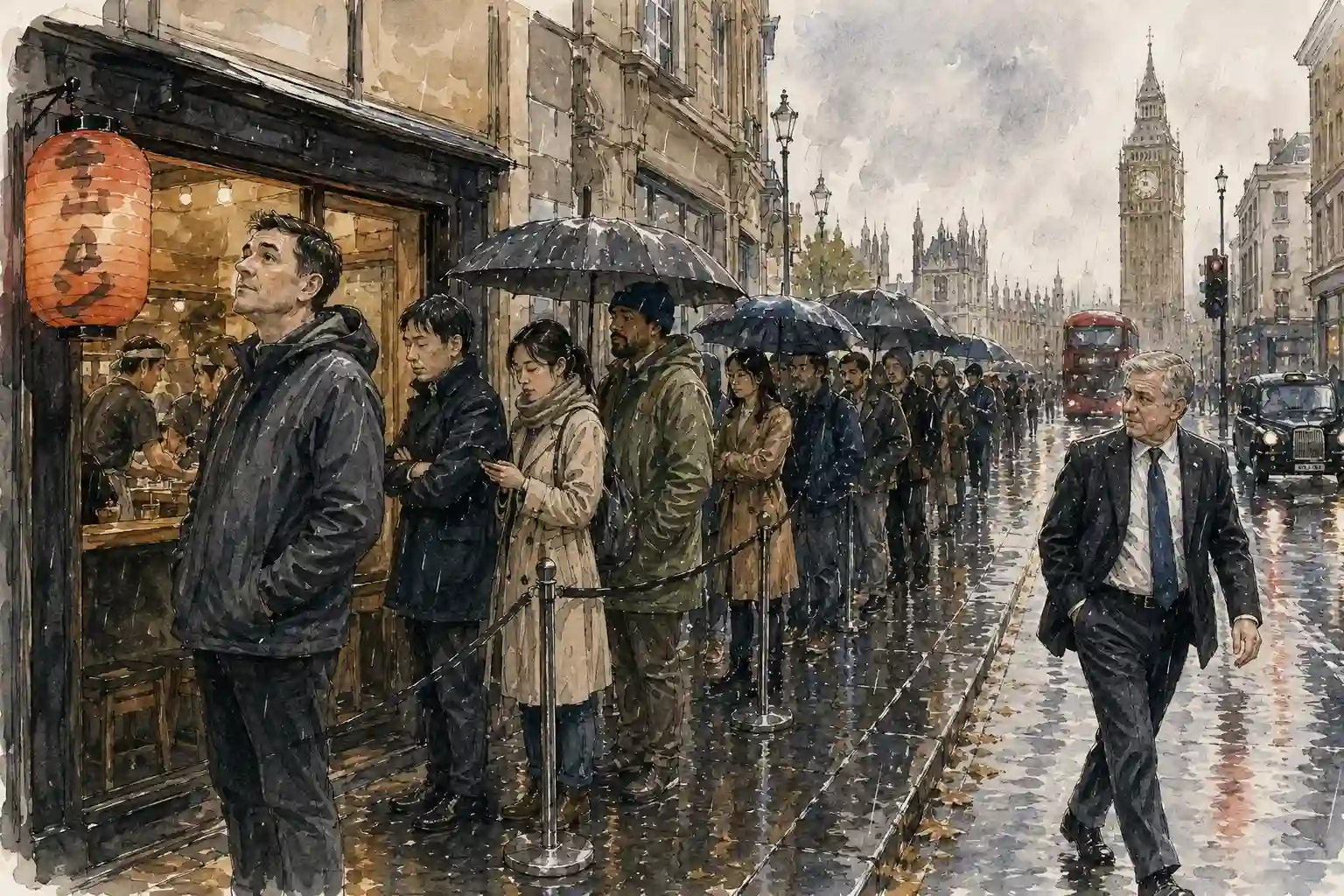
Trip after trip, umbrella in hand, London kept revealing itself.
Dalston smelled of wood ovens baking Kurdish flatbreads. New Malden — an otherwise forgettable suburb — had quietly become the largest Korean community outside Korea. Bibimbap in a strip mall? Extraordinary. Then came Peckham, where “Don’t go after dark” turned into a delectable plate of smoky, spicy jollof rice served by a young Nigerian couple who had come to Britain seeking stability.
I’ve been coming back for thirty-five years. Every trip, a new flavor. Every new flavor, a new community that somebody wanted to keep out.
“I’m an alien, I’m a legal alien”
I expected my current trip to England to be utter chaos. From America, every headline suggested a country in crisis — immigration protests, rising street crime, strained public services, and another prime minister coming and going.
So I again channeled the daring Englishman to investigate. I saw no protests. No hostilities. Londoners were simply going about their day.
I spoke to dozens of friends. The complaints focused mostly on Brexit. Fewer jobs. Sluggish economy. High college tuition abroad. When I asked women directly if they were afraid to go out after dark, the answer was universal. None felt it necessary to change their lifestyles.
I shouldn’t have been surprised. It felt like another version of the same story I’d been hearing for decades.
Meanwhile, when Michelin recently handed out stars, an astonishing 88 restaurants were recognized. This year’s new stars included Korean, West African, Vietnamese, Thai, Indian and Eastern Mediterranean.
I put away my umbrella this trip thanks to the heat wave. Of course, I sampled the old favorites — fish & chips, curry, Jamaican patties. My new memory is the wonderful flavors of fresh coconut, chiles, and lemongrass from an Indonesian hole-in-the-wall in a “sketchy” part of the City.
The Englishman in New York was looking for home in a foreign city.
I keep coming back to London because the foreigners made London one.

All the World’s a Stage
Make sense of the week's news.
Charlatan reviews the worldview.
CHARLATAN
The Exposé of Politics & Style