CHARLATAN
The Exposé of Politics & Style
On February 28, the United States and Israel launched airstrikes on Iran, killing Ayatollah Khamenei. Hours earlier, an Anonymous Polymarket account made $550k on a bet that the strikes would happen and he’d be removed. A strange parlay even by today’s gambling standards.
Then came April 7 the Ceasefire. Curiously, fifty new accounts bet heavily on peace and made $374k while the President was cosplaying a James Bond villain and threatening annihilation on social media. All 50 got it right — and got paid.
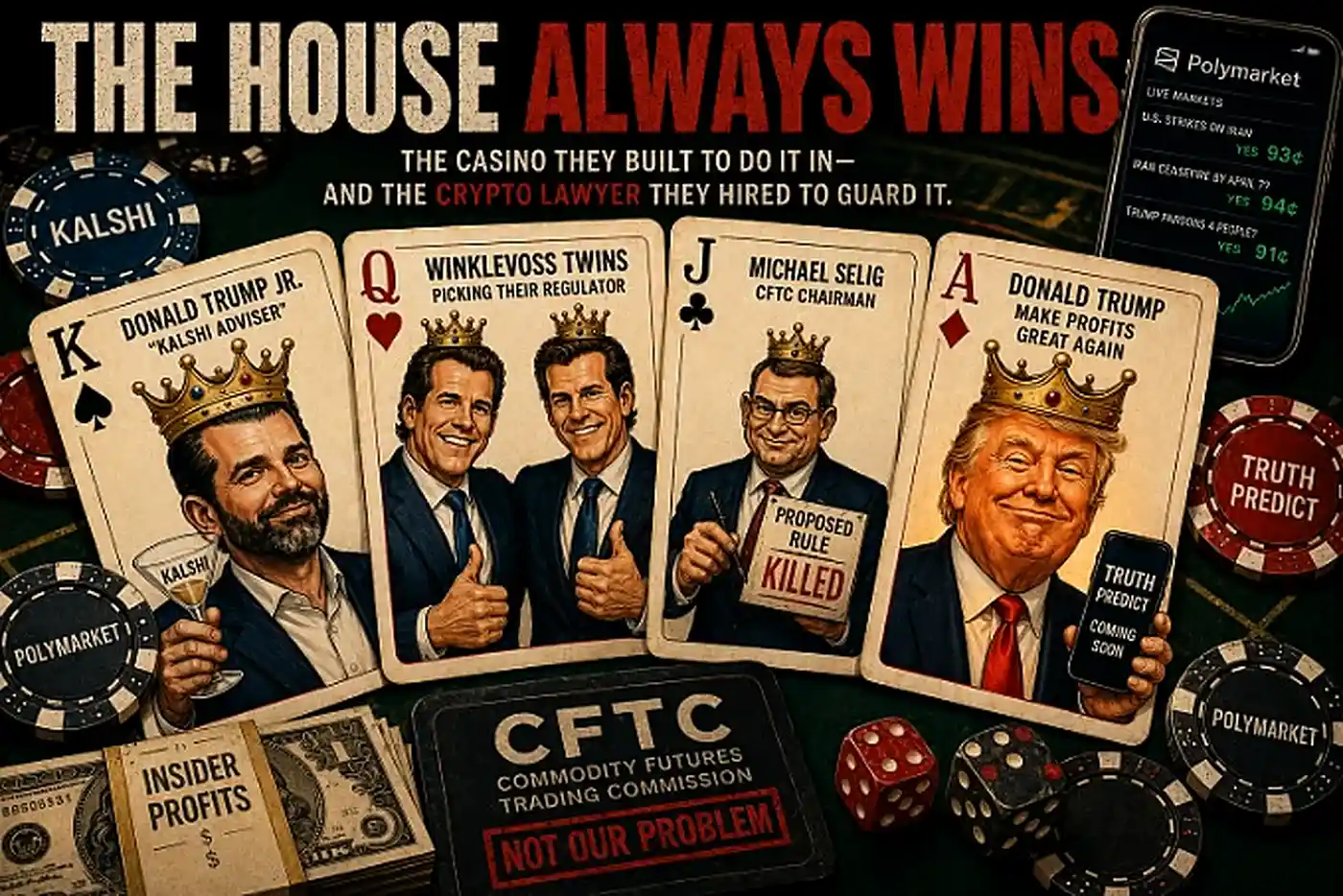
Regulators CFTC? Silent. Its new Chairman, Michael Selig — former crypto industry lawyer — killed the proposed rules restricting prediction markets as his first act.
Meanwhile, The White House, which glowed a ghastly bright blue when we sprayed Luminol at the Washington Insider Trading crime scene last week, has also been funeral quiet. Did you know the Trumps also profit from these platforms? We’ll get to that too.
IT STARTED IN A CLASSROOM
Most people think Prediction Markets were started by Wall Street. Actually, they were invented at the University of Iowa in 1988 as an academic experiment to test whether collective small-wager betting could outpredict Gallup polls. It consistently succeeded, correctly calling Bush in ‘88 and Clinton in ‘92, which intrigued economists. Yet this marketplace was largely ignored outside of academia for 30 years until 2018, when two MIT graduates founded Kalshi and an NYU dropout built Polymarket on crypto infrastructure.
Riding the global wave of legalized gambling, the two platforms exploded and now generate $28 billion in monthly trades. The Iowa professors built a vastly superior pollster. Wall Street erected an outrageously lucrative casino on top of it and didn’t even send them a Thank You Note.
The sales pitch never changed: these aren’t bets, they’re event contracts. Not gambling — price discovery. The wisdom of crowds. What the U of I crafted to beat Gallup has now graduated to major world events — and the “wisdom of crowds” often includes people with security clearances betting on geopolitics while the public obsesses over more colorful bets like the Second Coming, real vampires, or cloning dinosaurs.
THE SCOREBOARD
The Iran Ceasefire trades may be the most egregious example but sadly there are plenty more. Here’s just a sample.
The Congressional Candidates — 2024
Three candidates (both sides of the aisle) caught betting on their own races and paid small fines.
“ricosuave666” — June 2025
A new account bets on Israeli strikes on Iran, wins $155,000 and then deletes account.
The Biden Pardon Trader — January 20, 2026
Anonymous account correctly predicts four Presidential pardons right before announcement, netting an easy $317k.
The Venezuela Trade — January 2026
Master Sgt. Gannon Ken Van Dyke, who planned the Maduro capture, was busted after collecting $400,000. Van Dyke is the only person ever criminally charged for prediction market Insider Trading.
The Iran War Strike — February 28, 2026
Six new wallets made a fast $1.2 million betting on U.S.-Israeli strikes hours before they happened.
A recent study from Columbia Law School analyzed two years of Polymarket transaction data and flagged 210,000 suspicious trades representing $143 million in profits — all of it sitting in plain sight on a public blockchain. No regulator commissioned it. Two law professors did the CFTC’s job for them. Their response has been Crickets.
MEET YOUR REGULATOR
Remember how we wrote a letter last week to SEC Chairman Atkins? Meet Mini Me.
His name is Michael Selig — the Man with jurisdiction over Kalshi and Polymarket as CFTC Chairman. His resume: a decade working the regulatory system on behalf of the very industry he now regulates, promoted to become Atkins’ protégé and Chief Counsel on the SEC’s Crypto Task Force, then serendipitously handed the reigns to regulate said industry.
Selig’s predecessor, Rostin Behnam, resigned on Inauguration Day. His parting warning regarding prediction markets to the Financial Times: “The line is going to be very blurred about what is legal and what’s illegal.”
Trump’s original nominee was Brian Quintenz, another crypto lawyer. That pick collapsed in a feud with the Winklevoss twins, who wanted their own guy. Billionaires were reportedly fighting over who got to run their regulatory agency. When billionaires audition the regulators who oversee their casino, don’t be surprised when the industry hires its own Guardian.
Selig’s first act as Chairman was to kill the proposed rule that should have restricted prediction markets. Not reform it. Kill it. When Congress demanded action, Selig published what Washington calls an Advanced Notice of Proposed Rulemaking — not a rule, not a ban, just a formal request for public comment. Grilled by Congress, Selig delivered a comment box.
THE FAMILY BUSINESS
Donald Trump Jr. is a well-paid strategic adviser to Kalshi. His qualifications parallel Hunter Biden’s at Burisma. Trump is also a partner at 1789 Capital, which poured double-digit millions into Polymarket. And Truth Social — the President’s media company — is launching its own prediction market called Truth Predict. The Trumpino Family even sued Minnesota this month to block its ban on these platforms.
Donnie Junior claims he doesn’t trade on them or lobby officials. Even if true, conflict of interest doesn’t require personal bets. It requires proximity to a President who announces wars, ceasefires, and foreign policy on social media — moves that create millions for anyone who knows what’s coming. Fifty brand-new accounts knew peace was coming on April 7th. We’re gonna need more Luminol.
WHAT REAL COMPLIANCE LOOKS LIKE
No need to reinvent the wheel here. The fix is the same as Congressional Stock Trading: mandatory pre-clearance, holding periods, and trading barred on any contract connected to your policy responsibilities. The same rules everyone in financial services — from entry level to CEO — has lived by for nearly a century.
A new platform could easily implement real-time account surveillance using geolocation and account age. Fifty new accounts materializing minutes before a significant announcement and realizing a windfall would have triggered sirens and flashing lights at my firm. I know because I built the mousetrap. And nobody ever beat me.
I have a hypothesis.
THE ARCHITECTURE
To date, suspicious Polymarket accounts made $2.4 million betting on U.S. military involvement in Iran. The same federal government that launched those strikes has not charged a single political insider. The Trump Mafiosi profits when those platforms grow. The President’s appointee running the agency understands his marching orders.
On May 22nd, House Oversight Chairman James Comer had seen enough. He launched a formal investigation, subpoenaed the CEOs of Kalshi and Polymarket, and said it plainly on CNBC: “Members of Congress, the President’s administration, any government employee could use insider knowledge to make huge profits.” Documents due June 5th.
Last week: Atkins and the SEC. This week: Selig and the CFTC. Different agency, different newly-appointed Chairmen, same mandate, same architecture — put an Enabler in the chair, clear the regulatory runway, and let the game run.
The scoreboard says it’s working. Congress finally noticed.
We noticed too. We're Charlatans. We have a Million Eyeballs on them.
As You Like It
The Week's Stocks, Risks,
Tips & Tricks on Wealth
CHARLATAN
The Exposé of Politics & Style