The Pilgrim’s Progress
As we sit down to Thanksgiving dinner, managing editor MARY BONELLI ASHWORTH summons her Pilgrim ancestors to the stage and scene of the American dream.
By Mary Bonelli Ashworth26 November 2026
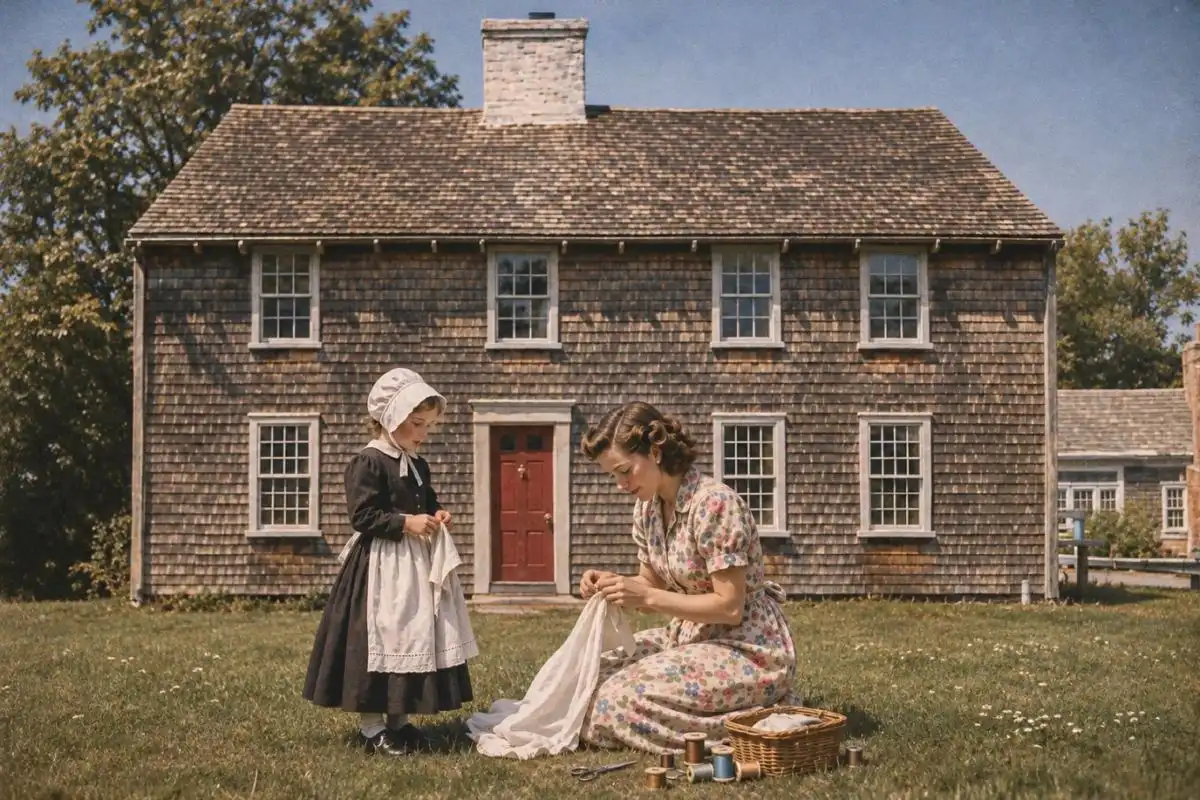
When I won the role of Priscilla Mullins, the real-life ingénue of Henry Wadsworth Longfellow’s 1858 poem “The Courtship of Miles Standish,” the casting call produced a rather punishing call sheet. I’d need to memorize the entire script; portray an iconic American character; and somehow create an authentic Pilgrim’s costume for a formal dress rehearsal scheduled for the very next day. Equal to the task, I leaned into the challenge with the gumption of any 7-year-old starring in a Thanksgiving play.
What could've seemed a predicament to most was no match for my mother, who, by happy coincidence, had been a dress designer and seamstress at Switzer’s Department Store, and undeterred by her elementary school daughter’s misunderstanding of the dress rehearsal’s date and time, quickly leaned into the project by threading a needle, seating a bobbin, setting the stitch, and lowering the presser foot into the wee hours of the night, which produced a designer-quality black dress, starched white apron, and picture-perfect Pilgrim’s bonnet by morning.
An elementary school teacher by trade, she lived by what has been described as having a “diamond in your apron pocket,” where knowledge and experience combine into words of wisdom and seemingly selfless acts of service.
Of Plymouth Plantation
Portraying the Pilgrim Priscilla Mullins Alden sparked a lifelong curiosity that eventually led me to William Bradford: an English Separatist; a signatory of the Mayflower Compact; and later Plymouth Colony’s governor for roughly thirty years. He’s best known for guiding the Plymouth Colony — the first permanent English colony in New England — and for recording the colonists' survival struggles in "Of Plymouth Plantation."
The only eyewitness account of the first Thanksgiving was written by fellow Pilgrim Edward Winslow. In a letter home in 1621, he describes the arrival of the Wampanoag leader Massasoit "with some ninety men, whom for three days we entertained and feasted." The Wampanoag, he noted, went out and killed five deer for the occasion. Who knew the first Thanksgiving feast was actually a potluck dinner?
The saga begins in 16th century England, when Separatists — English Protestants who wished to separate from the Church of England — ran afoul of the Act of Uniformity (1559). Missing church without a valid excuse carried a fine of 12 pence (a shilling) per absence, collected by parish churchwardens. Repeat offenders called "recusants" faced escalating fines, seizure of property, and imprisonment.
Fines, surveillance, imprisonment, and seizure persisted for some 50 years before a group of radical English Protestants — the Scrooby congregation — fled in waves to Amsterdam and then Leiden in the Netherlands. After a dozen years abroad, fearing economic, religious, and cultural erasure, they set out for the New World in 1620. Their leaking companion ship, the Speedwell, turned back twice before being abandoned in England, and its passengers crowded onto the larger Mayflower, which sailed alone. Bradford logs their motives in "Of Plymouth Plantation":
Not out of any newfangledness, or other such like giddy humor by which men are oftentimes transported to their great hurt and danger, but for sundry weighty and solid reasons.
On 6 September 1620, the Mayflower set sail from Plymouth, England, across the Atlantic Ocean carrying 102 passengers on a rather grueling 66-day voyage accompanied by severe overcrowding, rampant seasickness, dwindling rations, and violent North Atlantic storms. When she anchored in Provincetown Harbor on 11 November 1620, 41 adult male passengers, intent on keeping order and unity among the settlers, signed the first written framework for self-government in what is now the United States. The Mayflower Compact begins:
Having undertaken, for ye glorie of God, and advancemente of ye christian faith… covenant, & combine our selves togeather into a civill body politick, for our better ordering, & preservation… to enacte, constitute, and frame such just & equall lawes, ordinances, acts, constitutions, & offices… for ye generall good of ye Colonie.
Nearly half of the Mayflower’s 102 passengers perished that first winter from the Great Sickness, a devastating wave of disease and starvation. Of the 18 married women aboard, fewer than a third survived, and Priscilla's family saga was sealed by Bradford's pen in a history of more than 100,000 words:
Mr Molines, and his wife, his sone, and his servant, dyed the first winter. Only his dougter Priscila survied, and maried with John Alden, who are both living, and have 11. children.
Two centuries on, one of Priscilla’s descendants, poet Henry Wadsworth Longfellow, decided Bradford had left out the best part. Lyrical lines would supply some romance.
In 1858, Longfellow published "The Courtship of Miles Standish," and our family's well-worn copy is still a treasure. Blustery Captain Standish, widowed that first winter, wants to marry young Priscilla but lacks the courage to ask. So he sends his scribe, John Alden, to propose on his behalf, and the plot thickens. John loves Priscilla, too, but bound by honor, he pleads the captain's case. Priscilla hears him out. Then, in seven well-chosen words, she rewrites the story:
"Why don't you speak for yourself, John?"
Longfellow's nine-part poem runs 1,018 lines through a war, a false report of the captain's death, and a wedding Standish survives to attend, asking forgiveness. In the end, the orphan of that first winter, accompanied by her groom at her bridle, rides off toward a new beginning like a queen on a snow-white bull. The poem ends there. Their legacy does not. A girl who outlived her family, and a scribe who finally spoke up for himself, produced a poet, two U.S. presidents, and eleven children whose stories continue to unfold around the world today.
To my delight, I later discovered — on an outing to the LDS FamilySearch Library in Salt Lake City, Utah — that John and Priscilla Alden are my 8th great-grandparents. Or in genealogy shorthand—8x GREAT. I and we are among the new beginnings Priscilla rode toward in the New World, and that legacy is every American's to preserve, protect, and defend.
Ashworth Acre
While the exact count fluctuates based on the in-law sharing schedule, nearly one hundred of us gather in Gunlock, Utah, every Thanksgiving. We gather from as far and wide as Norway, France, and Hawaii, as well as from major metropolises in Michigan, Iowa, Missouri, Oklahoma, and Massachusetts. Others come from one-stoplight towns in Arizona and Texas, and still others call Gunlock their home. I and we represent four living generations of one family gathering in one place.
The Thanksgiving feast, of course, is a real spotlight. Tables are festooned in autumn leaves with antique Pilgrim figurines on display, liberated annually from their hiding places. A heartfelt prayer of thanks to God for manifold blessings begins the feast, and as the bowtie rolls make the rounds, the story of John and Priscilla is retold. Increasingly, in the voice of a new generation.
Yet after enlightenment, there is still the laundry. We all like to point to the mess and expect someone else to handle it to our satisfaction, only to find they never quite rise to our esteemed standards. If the Pilgrims fled religious persecution, it was James Madison who later forged their plight into the steel of the soul of the nation. "Congress shall make no law respecting an establishment of religion, or prohibiting the free exercise thereof." The First Amendment — providing for the freedom of speech and freedom of religion — works just that way at the American dinner table, too. God, as it happens, is in the details.
Thanksgiving traditions aren’t simply gratuitous dinner occasions saved for a single Thursday in November. They’re a living discipline, one my late husband, Senator Don Ashworth, practiced at our family table all year round by holding thirty seconds of silence before every meal and then calling on one or two people to share what they were thankful for. Across a 55-year marriage, our dinner table was a chapel of democracy where young congregants, visiting dignitaries, and a larger community of extended and chosen family all cobbled together their own versions of the American dream.
Our shared lineage in the esteemed Alden family name may connect Priscilla and me, but of those Pilgrims who survived that first winter there are nearly 35 million descendants who can trace their ancestry to the Mayflower worldwide, and to that first Thanksgiving in America.
Nearly 5.4 billion people — roughly 65% of the world’s population — live in countries with serious or very serious violations of religious freedom, according to the 2025 Religious Freedom in the World Report. Leaving those who remain free to carry on and to decide how best to serve both God and man.
Tradition, T.S. Eliot wrote, "cannot be inherited, and if you want it you must obtain it by great labour."
Life isn't a dress rehearsal, as they say, but it never hurt a Pilgrim, schoolteacher, or a dinner guest to treat it that way. What comes of our small talents, chores, and traditions? Winslow answered in his famous closing line on the feast: "We are so farre from want, that we often wish you partakers of our plentie."