CHARLATAN
The Exposé of Politics & Style
Four Seasons Lion Palace
St. Petersburg doesn't need an introduction. It needs a warning label.
This is the city that gave the world Peter the Great, Catherine the Great, the Romanovs, the Revolution, the Siege, and approximately 400 years of architectural one-upmanship so relentless it makes Versailles look like a starter home. To arrive here and check into the Four Seasons Lion Palace is not merely to book a hotel room. It is to declare, with your credit card, that you have chosen a side — and the side you have chosen has heated floors, Hermès toiletries, and a rooftop pool hovering above a city that once ate its zoo animals to survive a Nazi blockade.
Peter the Great, who founded St. Petersburg in 1703 by draining a swamp and installing an empire, preferred spartan quarters and hands-on governance — the kind of czar who worked the shipyard alongside his own laborers and considered dental extraction a reasonable hobby. He would have found the Four Seasons Lion Palace grotesque. Catherine the Great, who succeeded him by successfully navigating the world's most dangerous game of palace politics, would have considered it a modest weekend retreat and quietly commissioned something larger.
Vladimir Putin, who governs from Moscow but was born in this city, who rose from KGB obscurity to czar-in-all-but-name over the course of three decades, and who this week quietly admitted that his war in Ukraine is coming to an end — Putin would recognize the Lion Palace immediately. Not as a hotel. As a negotiating posture. All marble and gold leaf and implied permanence, projecting strength from a position that is, upon closer inspection, already in retreat.
We noticed our own retreat was being monitored from the moment we descended the Lion Palace's grand staircase on the first morning. The man in the grey coat was already there. He was there the second morning too. And the third. He was never close enough to be confrontational and never far enough away to be coincidental. This is St. Petersburg's oldest courtesy — the city has been watching its visitors since the czars made it fashionable, and the habit, it turns out, did not dissolve with the Soviet Union. Every departure from the hotel was noted. Every return was clocked. The gold leaf on the ceiling caught the light beautifully and two floors below, in the lobby, someone was writing something down.
The retreat did not announce itself with a press conference. It rarely does. It arrived instead as a sequence of events that, taken individually, might be dismissed as coincidence, but taken together constitute something closer to a verdict. In Budapest, Péter Magyar — a divorced lawyer with a viral video, a grudge, and twenty years of institutional memory — won 138 of 199 parliamentary seats on 79 percent turnout and ended sixteen years of Viktor Orbán's illiberal rule in a single evening. Orbán conceded in under three hours. With him went Moscow's last reliable veto inside the European Union. Hungary had been Putin's diplomatic beachhead in Brussels — blocking aid packages, maintaining energy ties, providing cover. That cover is gone. The wagon circle tightened by one, and the one that left was the one holding the gate open.
In Warsaw, Polish Prime Minister Donald Tusk posted "Ruszkik haza" — Russians, go home — on the night of Magyar's victory, and meant every syllable. In Brussels, Ursula von der Leyen said Europe's heart was beating stronger in Hungary. The €18 billion in cohesion funds frozen since 2022 began moving again. The EU's eastern flank — Poland, the Baltics, now Hungary — is consolidating into something Moscow cannot penetrate by conventional diplomacy, cannot fracture by energy leverage, and cannot outlast by simply waiting. The wagons, long fractious and pointed in different directions, are circling. And the circle is closing around Russia.
Meanwhile, in Beijing, Air Force One touched down on a Wednesday evening. Thursday brought the ceremony, the bilateral, the Temple of Heaven. Friday, a state banquet. The full imperial pageant — a handshake here, a photograph there — while Taiwan's President Lai Ching-te was in Taipei, issuing statements that no one covered, watching two men dine on his future in a room he was never invited to enter. Trump flew to China and sat across from Xi Jinping, the man who has spent the last seven weeks watching U.S. military tactics in the Gulf with the patience of someone studying for an exam he intends to pass. The subject of Taiwan was not on the agenda. It was the agenda. It was simply never said out loud.
What Trump's Beijing visit communicated to Moscow — and this is the piece of the puzzle Putin is sitting with this week — is that Washington's strategic attention has migrated. Iran. China. Trade. Ukraine is no longer the gravitational center of American foreign policy. It is a prior commitment, a sunk cost, a file on a desk that keeps getting moved to the bottom of the pile. For three years, Putin's most reliable narrative was that Russia was fighting American imperialism by proxy. That narrative requires American attention. Attention that is now, demonstrably, elsewhere.
We returned to the Lion Palace each evening through the same entrance, past the same doormen in their imperial livery, and up the same grand staircase — and each evening the grey coat was somewhere in the vicinity of St. Isaac's Square, noting the hour. It is not an unpleasant feeling, being watched in St. Petersburg. It is, in its way, a form of hospitality. The city has always taken its guests seriously. Peter the Great built it as a window to the West, which implies, of course, that someone was always meant to be looking through it — in both directions.
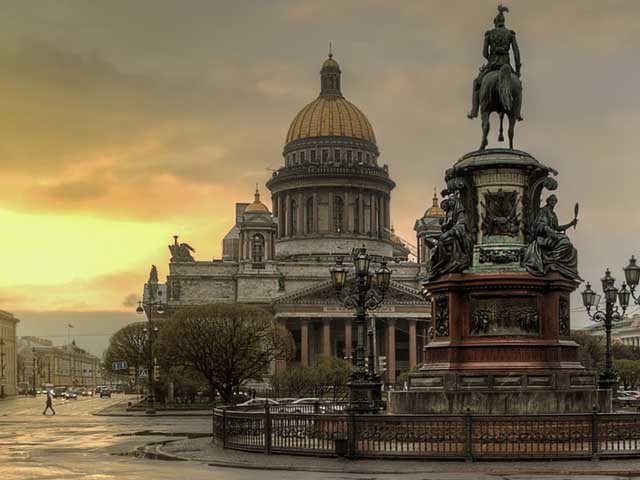
The Lion Palace itself was built in 1817, renovated over six years into its current incarnation of 177 rooms and 26 suites — each overlooking St. Isaac's Square, the Admiralty Building, and a cathedral so preposterously grand it took 40 years to construct and required 100 kilograms of gold for the dome alone. Your room looks out on all of this. The L'Occitane is in the bathroom. The Illy espresso machine is on the counter. Nicholas II, who held the last imperial court in this city before the Bolsheviks made other arrangements, did not have an Illy espresso machine. He also did not have the Four Seasons' 24-hour Business Center, eight-treatment-room spa, or Teppanyaki table. History is not without its ironies.
Descend into the Grand Ballroom — nearly 10,000 square feet, the largest in St. Petersburg — and the ironies compound. This is the city of revolution, of bread lines and collective farms and the systematic dismantling of imperial excess, and here you are in a room that rivals the Winter Palace, deciding between the tasting menu and the à la carte. The Xander Bar, clubby and amber-lit, is where Dutch naval officers drink cognac beside oligarchs' nephews while a jazz pianist navigates the geopolitical tension with something from the American Songbook. It works. It shouldn't, but it does.
Sintoho, the hotel's Asian-fusion restaurant drawing from Hong Kong, Tokyo, and Singapore, seats guests alongside local St. Petersburg society in a city that has spent three centuries deciding whether it is European, Asian, or magnificently, defiantly neither. The wine cellar is the city's finest. The sushi bar is excellent. Peter the Great, who spent his reign building Russia's window to the West, would have found this profoundly satisfying and deeply suspicious in equal measure.
On our final evening, descending the grand staircase for the last time, we looked for the grey coat. He was there — of course he was there — stationed at a respectful distance near the entrance to St. Isaac's Square, hands in his pockets, watching the door. We nodded in his direction. He did not nod back. This is also a St. Petersburg tradition: the acknowledgment that goes unacknowledged, the watching that dare not speak its name. Peter built the city as a statement. Catherine gilded it. The Soviets weaponized it. And now it sits in the amber light of a late imperial evening, beautiful and surveilled and slightly absurd, full of Dutch naval officers and Hermès soap and men in grey coats who are very definitely not following you.
St. Petersburg was designed, from its marshy origins, to be impossible — an imperial capital built by decree on a floodplain, a European city planted in Russia, a monument to the proposition that sheer will can override geography, climate, and common sense. The Four Seasons Lion Palace is, in this respect, the most St. Petersburg hotel imaginable: a place that takes the city's foundational absurdity and charges handsomely for the privilege of participating in it.
Empires, it turns out, are easier to build than to keep. Peter knew it. Catherine knew it. Nicholas II learned it the hard way, in a basement in Yekaterinburg. And somewhere in Moscow this week, the man born in this city — the one who dreamed of restoring what was lost, who sent tanks into Ukraine to prove that history could be reversed by force, who built his own empire on the premise that the West was too distracted and too divided to hold the line — is learning it too. Budapest held the line. Brussels held the line. And in Beijing, over a state banquet that never once mentioned Taiwan, the West's most powerful leader looked across the table at the man who has been watching, waiting, and studying — and offered him a photograph.
The Four Seasons remains. The empire, again, is in retreat.
Catherine would have approved of the hotel. She would have had thoughts about the retreat. Peter would have ordered another round and gotten back to work. And the man in the grey coat — patient, unhurried, professionally invisible — will be there tomorrow morning when the next guest descends the staircase, as he was there for us, as he has always been there, as he will always be there, because in St. Petersburg, some things do not retreat. They simply wait.

All the World’s a Stage
Make sense of the week's news.
Charlatan reviews the worldview.
CHARLATAN
The Exposé of Politics & Style