CHARLATAN
The Exposé of Politics & Style

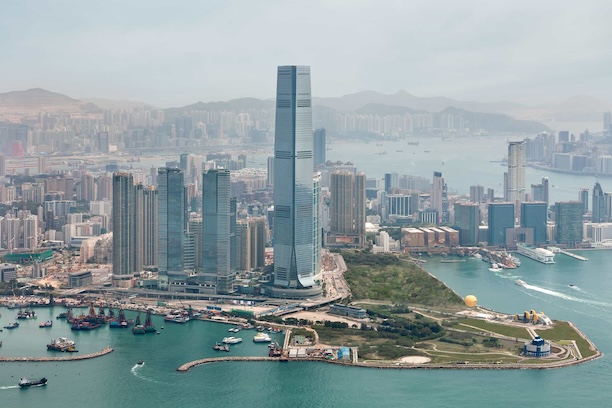
The elevator ride alone was a statement. Floors 102 through 118 of the International Commerce Centre on Kowloon Island — the world's highest hotel, the Ritz-Carlton Hong Kong — required a journey that felt less like checking in and more like ascending into a different category of existence. Gold and silver. Snakeskin and lacquer. Marble, glass, and chrome. And then, through the floor-to-ceiling windows, the view: Kowloon spread below like a circuit board lit from within, Victoria Harbour catching the last light, the Night of Lights show pulsing across the skyline with the punctuality of a market open.
I had moved to Hong Kong a few months earlier to help my firm develop its Asia Pacific presence. It was 2015. The city was nearly twenty years into its handover to the People's Republic of China, and what struck me most — what struck every Western banker who landed there — was how little it felt like China. Hong Kong was cosmopolitan, individualistic, freewheeling. It was a melting pot operating at the speed of capital. The property boom was extraordinary. The synergy between the PRC and its Special Administrative Region felt, to those of us standing inside it, like a formula for success.
I wrote those words then. I believed them. I was not naive. I was simply standing in the wrong decade.
What I was watching from the 102nd floor — the harbor, the skyline, the orderly churn of one of the world's great financial engines — was a city operating under a guarantee. One Country, Two Systems. Fifty years of autonomy, promised by Beijing at the 1997 handover, codified in the Basic Law, underwritten by the Sino-British Joint Declaration. Hong Kong would remain Hong Kong. Its courts, its press, its right of assembly, its freewheeling capitalism — all of it protected, all of it intact, until 2047.
Beijing didn't wait until 2047. It didn't wait until 2035, or 2030, or 2025. It took seven years.
In 2020, Beijing imposed the National Security Law — a piece of legislation so broad in its definitions of sedition and foreign collusion that it functionally criminalized dissent. What followed was not a crackdown in the cinematic sense. There were no tanks. There was no single defining image the cameras could freeze and the world could rally around. It was quieter than that, and therefore more thorough. Political parties dissolved. Independent newspapers shuttered. The Hong Kong Journalists' Association reported that press freedom scores among its members dropped for five consecutive years, reaching 25 out of 100 by 2024. Nine hundred journalists lost their jobs. Universities rewrote their curricula to include national security education. Libraries required special registration to access books about Tiananmen Square. Catholic churches canceled memorial masses for the massacre's victims three years running, citing the legal risk of commemoration.
Jimmy Lai — media tycoon, founder of Apple Daily, the most prominent pro-democracy voice in the city — was arrested in 2020, held in solitary confinement, tried without a jury over five years, convicted on charges of foreign collusion and sedition, and sentenced in February 2026 to twenty years in prison. He is seventy-eight years old. His newspaper no longer exists. His crime, in the plainest terms, was believing that the guarantee meant something.
The Ozone Bar on the 118th floor still operates. The harbor view is still breathtaking. Hong Kong's GDP grew 5.9 percent in the first quarter of 2026 — its strongest quarterly performance in nearly five years. The Hong Kong Stock Exchange ranked first in the world for IPO funds raised in the first half of 2025. The numbers, taken in isolation, tell a story of resilience. They are not wrong. They are simply incomplete. Hong Kong Monetary AuthorityHKTDC Research.
What the numbers don't capture is the population bleeding out through the exits. Since the National Security Law passed, an estimated 200,000 Hong Kongers have emigrated — to Britain, to Canada, to Australia, to anywhere that doesn't require registration to read about its own history. The skilled workers who built the financial infrastructure that makes those GDP numbers possible are leaving at a rate that analysts describe as a longer-term structural risk to the economy. The bankers and brokers who used to pack the Ozone after market close are increasingly packing their families instead. U.S. Consulate General Hong Kong & Macau.
Hong Kong's role as a "super connector" between mainland China and the rest of the world remains its primary economic argument for existence. And here is where the picture becomes genuinely complicated, because that argument is not wrong either. As American firms pull back from mainland China listings under geopolitical pressure, Hong Kong absorbs the overflow. As Chinese companies seek offshore capital, Hong Kong remains the preferred address. The financial plumbing still works. The question is what it is now plumbing for, and in whose direction. ASEAN+3 Macroeconomic Research Office.
When I arrived in 2015, Hong Kong was a gateway — in both directions. Capital flowed west, ideas flowed east, and the friction between the two systems produced something genuinely valuable: a city that was neither fully Chinese nor fully Western, that translated between two worlds with the fluency of long practice. That translation function made it indispensable. It also made it threatening. A city that speaks two languages is a city that can say things Beijing doesn't want said.
The National Security Law solved that problem. Hong Kong still speaks two languages. It has simply been taught which one to use in public.
I think about the Yin and Yang passage I wrote at the end of my original dispatch — the Chinese philosophical concept that polar opposites are intertwined, that opposites only exist in relation to each other. I meant it as a meditation on the distance between my modest apartment and the soaring Ritz-Carlton a few city blocks away. I did not mean it as prophecy. But there is something to it now that I couldn't have seen from the 102nd floor in 2015. The opposite of One Country, Two Systems is One Country, One System. The opposite of a guarantee is its revocation. And the distance between them — the distance between what Hong Kong was and what Hong Kong is — turns out to be not fifty years, not a generation, not even a decade.
It turns out to be a law. A few pages of legislation, passed in Beijing, imposed without a vote, and the city I moved to in 2015 was gone.
The Ritz-Carlton still stands on Kowloon Island. The Night of Lights still plays over Victoria Harbour on schedule. The GDP numbers are, by any measure, respectable. But the formula for success I wrote about eleven years ago was operating on a premise that Beijing has since withdrawn. The synergy I admired was always conditional. The cosmopolitanism I fell in love with was always on loan.
I did not know that from the 102nd floor. I know it now.
And somewhere across the Taiwan Strait, ninety miles from the Chinese coast, twenty-three million people know it too.

All the World’s a Stage
Make sense of the week's news.
Charlatan reviews the worldview.
CHARLATAN
The Exposé of Politics & Style