Honey Trap
The crown jewels of global A.I. dominance have been leaking to China. Charlatan follows a sex scandal to a national security failure, a “Chinese intelligence asset” and the Thucydides Trap.
15 November 2026
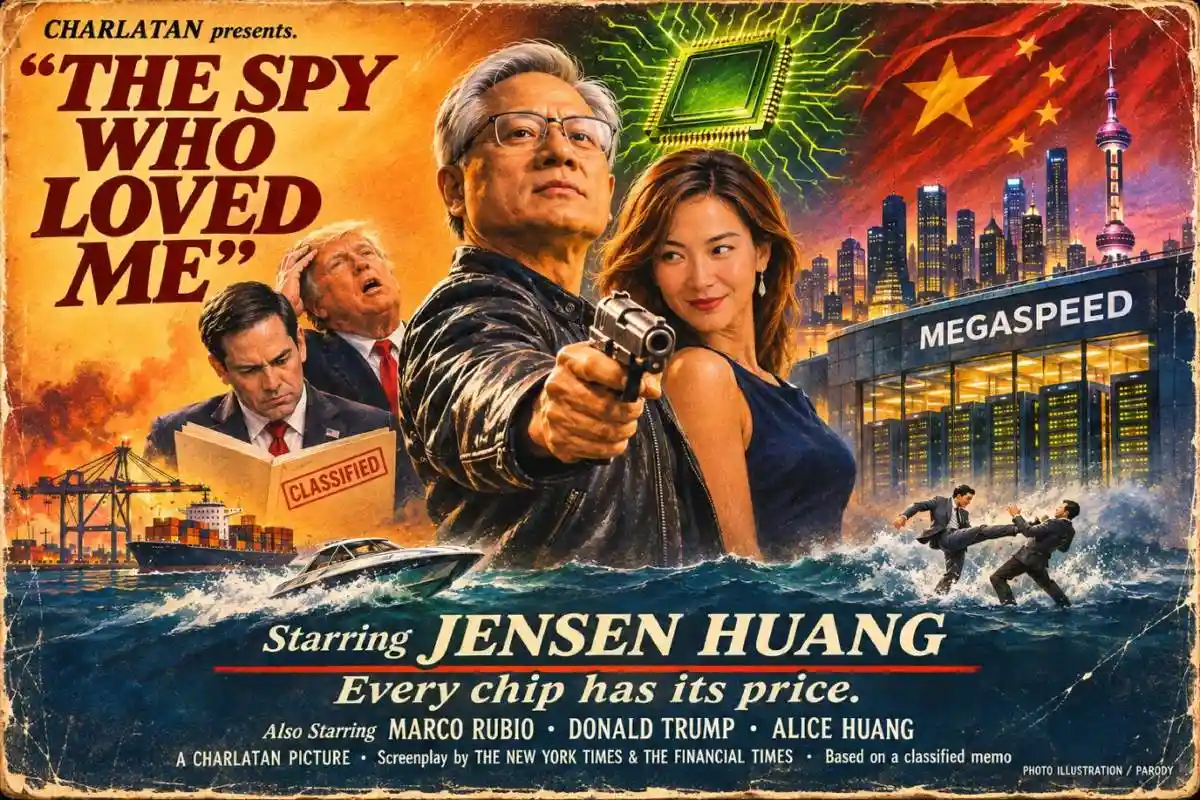
If you have a 401(k) or an index fund, you probably own a piece of Nvidia. Its chips dominate the market for A.I., and the country that controls them will set the rules for the technology that shapes what we earn, what we know and how we fight. For now, that country is the United States.
On November 11, Jensen Huang resigned as chief executive of Nvidia, the company he co-founded 33 years ago and built into the engine of the A.I. boom. He had admitted an affair with a woman U.S. intelligence believes was working for Beijing. Then the Times reported a second, with an executive who reported to him. His board accepted his resignation that night. Reuters has since reported a third, with another Nvidia employee. Shares fell as much as 14 percent at Thursday’s open. Thursday’s close: $166.19, down 4.34 percent.
Since 2022, U.S. export controls have kept Nvidia’s most powerful chips out of China. Last December, Trump loosened the rules: Nvidia could sell China its second-best chip, the H200, with Washington taking a 25 percent cut. Chinese tech companies ordered more than 2 million. Then Beijing blocked them at customs. It never said why. It didn’t have to: self-sufficiency, control, supremacy. But its companies still wanted Nvidia’s best, the ones U.S. law forbids. Beijing closed the front door. The back door stayed open. U.S. intelligence says Alice Huang was standing in it, beside Jensen Huang. Behind every great man, they say, is a woman. Behind this woman, a classified U.S. memo says, stood China’s spy service.
The front door had cracks of its own. According to the Times, some Chinese firms cleared to buy H200s have empty offices; one appears to be a front company, and others are tied to companies on a U.S. trade blacklist. Megaspeed, the company Alice Huang ran, has never been added to that list.
At the crux of the scandal lies the Thucydides Trap: What happens when a rising power threatens a ruling nation?
“The world has come to another crossroads,” Chinese President Xi Jinping said at the Great Hall of the People in May. “Can China and the United States overcome the so-called ‘Thucydides Trap’ and create a new paradigm of major-country relations?”
The Woman at the Bar
In early June 2024, Alice Huang was drinking with technology executives in Taipei. She told the table she could bring Jensen Huang. He came. The two are not related.
Alice Huang, also known as Huang Le, is a Chinese citizen who ran Megaspeed, a Singapore data-center company spun off from a Chinese gaming firm in 2023. Weeks after that night, Megaspeed began buying Nvidia’s most advanced processors through a Malaysian subsidiary, nearly $2 billion worth by the Commerce Department’s count. Customs records from Malaysia and Indonesia put the total since 2023 at a minimum of $4.6 billion in Nvidia hardware, roughly 136,000 GPUs.
In May, the short seller Culper Research, which profits if Nvidia’s stock falls, cited filings showing that in June 2024, the month of the night in Taipei, Megaspeed’s Malaysian subsidiary pledged its entire business as collateral to a Singapore procurement company owned by Alibaba. Megaspeed and Alibaba have not publicly addressed the claim.
When a Commerce official visited Megaspeed’s Malaysian data center, the GPUs were in boxes rather than installed in racks. They had either just arrived or were about to leave. Commerce opened an investigation in late 2024.
Megaspeed imported at least $4.6 billion in Nvidia hardware since 2023.
What the Spies Heard
U.S. agencies were watching Alice Huang before they knew who she was meeting. Electronic surveillance showed her passing information to Beijing. It also showed an American on the other end of her calls. Intelligence rules mask U.S. citizens’ names in intercepts. When officials unmasked this one, it was Jensen Huang.
Officials did not believe he knew what she was. Some senior administration officials have doubted that. He was never given a defensive briefing; the warning counterintelligence agencies give Americans targeted by foreign spies.
This spring, according to The New York Times, Secretary of State Marco Rubio oversaw the memo that put it in writing for senior officials before Trump’s May trip to Beijing. Her assignment, it said, was to gather information on Huang and to push for Nvidia’s advanced chips to reach China. The Financial Times later reported that the memo described the relationship as romantic. President Trump was briefed on the intelligence roughly a year ago. He took no action.
The Fall
On October 29, the day the Times published, Huang described his dealings with Alice Huang as normal customer business. Ten days later, on Sunday, November 8, he wrote to Nvidia’s employees. “I was unfaithful to my wife,” he said, adding that there was no excuse. He did not name her. According to the Times, he named her to the board.
The board opened an independent investigation and said it had confidence in him. Nvidia shares closed down more than 4 percent on Monday, November 9. Within minutes of the close, a shareholder sued Nvidia and Huang, alleging investors were misled about the affair and its national security risks. On November 11, citing five people who had worked at the company, the Times named the second woman: Kimberly Powell, Nvidia’s vice president of health care, who reported directly to Huang. Nvidia, Huang and Powell have not confirmed it. That night he was out. Colette Kress, the chief financial officer, is interim chief executive. Harvey Jones, a director since 1993, is the board’s first chair.
On November 11, Nvidia’s board accepted Jensen Huang’s resignation after 33 years.
What Washington Knew
Huang advised Trump on A.I. and flew with him to Beijing in May, and Nvidia has donated to Trump’s ballroom. The H200 deal went ahead anyway.
Commerce’s Megaspeed investigation stalled after Nvidia’s general counsel contacted the agents running it in August 2025, citing permission from Jeffrey Kessler, who runs Commerce’s export bureau and reports to Secretary Howard Lutnick, according to the Times. The Justice Department took over this year. House Democrats want Lutnick to say by December 1 what his officials knew. Axios reports that Lutnick has repeatedly stood in the way of efforts to crack down on companies suspected of diverting Nvidia’s chips to China.
Singapore was left on its own. It seized Alice Huang’s passport in June 2025, the day of a U.S. shipment check at Megaspeed, and held it for eight months. It says it repeatedly asked the Justice Department and the FBI for help and received “limited information or assistance.” In February, it returned her passport, let her leave and barred her from coming back.
On November 4, the Republican chairs of the House Foreign Affairs, Intelligence and China select committees asked Huang for a closed-door briefing. The China committee has called Alice Huang “a publicly reported Chinese intelligence asset.” Threatened with a subpoena, Huang has agreed to testify before Thanksgiving. Senate leaders of both parties say they want answers, and House Democratic leader Hakeem Jeffries is demanding a classified briefing for all members.
The Other Side
Nvidia calls Huang’s meetings with Alice Huang “not unusual or unexpected.” It says customers like Megaspeed receive ordinary business information, nothing touching national security, and that diversion allegations against Megaspeed were investigated and debunked last year. Megaspeed denies moving chips illegally and has hired outside lawyers to review the allegations. Alice Huang has not responded to requests for comment. Bloomberg reports she is living in Beijing.
Beijing’s Foreign Ministry calls the reports groundless speculation meant to smear China. Singapore says it investigated her over possible false declarations at Megaspeed, not espionage, and found insufficient evidence. Attorney General Todd Blanche says the Justice Department has not concluded whether she was a spy.
What is not known is substantial. No charges have been filed. No evidence has been made public. No one has said when she was recruited, how long the relationship lasted, or what, if anything, she learned. America has been here before: Katrina Leung, the FBI informant code-named Parlor Maid, and Christine Fang, who courted California politicians, were both suspected of working for Beijing. Neither was ever convicted of espionage.
What To Do About It
Watch two things. On November 17, Nvidia reports earnings, its first report without its founder; what it says about China, and about who will lead the company, will move the funds most Americans hold. Before Thanksgiving, Huang testifies to Congress.
Ask your representative whether that testimony will be public. Ask whether the administration will release or confirm any of the intelligence, and whether it will revisit the export decisions Huang helped shape.
The government has known for a year. The public has known for 17 days.