CHARLATAN
The Exposé of Politics & Style
President Drumph lowered himself into the tub with the confidence of a man who could walk on water. Steam rose, nevertheless. As if a thousand Empire State Buildings had exploded at once, water thrashing across the recently renovated black-and-white marble bathroom tiles. Somewhere beyond the gold-leafed door, his wife, "The First Lady," answered to her title — a pet name he invoked ad nauseam to remind himself he was still president. "Be Best," Banália whispered, through a crack in the door. One more Slovenian affirmation to meet the new American Moment.
On the marble ledge sat a leatherbound history of the Mexican American War, spine cracked to a chapter titled "Manifest Destiny and the Politics of Pretext." Drumph mused amidst the eucalyptus oils. "Says here this Polk fellow was one of the greats. So why haven't I ever heard of him?" He turned the thought over to illogical conclusion. "Very disrespectful."
"Sent troops right into the disputed zone. On purpose. And when they reacted, he said they started it." He nodded, confirming a theory he'd apparently held all along. "100 percent. I would've done the same. Bigger. And I'd lose the dark suit — looks like something a man wears when he wants to be forgotten. Red and blue photograph far better in Brioni."
He slurred the last part more quietly than he meant to, as he had so many times over the years.
A duck, small, plastic, entirely beside the point, drifted near his elbow.
"Canada's got the same problem Mexico had. We don't need their aluminum" — he paused, as if some buried fact had surfaced and been overruled — "and that water up there, not even named right. Lake Ontario? We're renaming it. Lake America." He repeated it, tasting it. "And New Mexico — New America. Many people suggested it." He did not say which people. "Strait of Hormuz, Trump Strait. Took that back in a few hours. I was joking. Mostly."
"Fifty percent, I put on them. Twenty billion, gone." He snapped his wet fingers, which made no sound. "The governor walked over some clause about who he's allowed to deal with. Like sovereignty's a thing you can just have." He offered everything, and got told his signature was pencil. "My signature. Pencil." He said it like it had insulted him personally. "At least it's not auto pencil."
"And Iran," he said, pointing a wet finger at the tile as if Iran were behind it. "Third carrier. The Roosevelt. Nearly ten thousand sailors and Marines, there by the end of November." He nodded, admiring his own timing. "Not before. After. You don't send a carrier early. That's called a schedule."
"People say, why not go in full? Maybe I don't. Because of the election." He said it plainly, the way other men read out a flight number. "Then the war ends. Immediately. They can't hold out. They're desperate to affect the election."
"Packed," he said of the convention. "Twenty-one thousand seats." The upper sections, reporters noted, had been largely empty. "Some guy in Texas says, privately, at a fundraiser, it dropped his numbers." He waved a wet hand. "Everybody's numbers dropped. That's not the convention. That's gravity." The duck, which heretofore had always voted by mail, drifted on.
"Canada wants the benefits of being our 51st state without paying in. That's not gratitude. That's tax-free amber waves of grain." He paused. For a moment his face held the stillness of a man arriving, by accident, at an actual thought.
"You know what Polk didn't have?" he scolded the duck. "A way to tell anybody. Added the western frontier and for what — a footnote?" He looked down at the book as though it had betrayed him. "That's not a legacy. That's a filing cabinet." The duck was finding its level.
"Where's this guy from. I bet it's small. Nobody's fixed it up." He said this with something almost like tenderness — a man recognizing, without admitting it, a smallness he feared in himself. Then it passed. "Banália! Where was Polk born. If it's small, we're gonna make it great again."
"M'husband, the great YOOO-nifier, let mama Google," she mused, in the flat twenty-two years of replies that were technically jibes. "Charlotte," she answers. "The Queen City."
The duck circled once and stopped, as if he, too, had reached the limit of his own frontier.
There was, by now, a woman whose entire job seemed to be paper. She printed what he was to read and did not print what he was not, and over time this had become less an administrative function than a kind of authorship — invisible, procedural, and absolute. Banália had never learned her title. Nobody used it. She was simply the one who prints things, the way a lighthouse is simply the light.
That week, after the executives had signed a promise to police themselves, the papers said a czar was coming, for the machines. Expected, not yet announced. Only high-IQ individuals need apply, Drumph had written, and the favorite already ran the spies. One guy, one door.
Drumph trusted paper more than screens — screens, he said, could be doctored, though paper, somehow, could not — and so everything reached him this way—if in synopsis. The Polk book had come to him this way too, Banália realized. Not a book so much as a printout bound to look like one. She wondered, not for the first time, what didn't make the stack.
She got her answer that afternoon, by accident. A box of archival material was delivered to the residence in error — meant for storage, not her desk — and she opened it herself instead of sending it back.
Most of it was Polk. A lock of hair nobody had thought to remove from its envelope. Near the bottom, tied in ribbon gone the color of weak tea, was a folder that wasn't his.
Sarah Childress Polk.
Banália knew the outline already, the way you know the outline of anyone who's been reduced to a paragraph in a textbook: married at twenty, no children, dead at eighty-seven having outlived him by more than forty years. What she hadn't known — what made her sit down on the edge of the tub, the folder open on her knee — was the rest of it.
That Sarah had run his correspondence, his press, his schedule, for six days a week, and that he'd called her indispensable and meant it. That historians would later just call her, plainly, without romance, the Gatekeeper — the one who decided what reached him and in what order, the one who read the newspapers first and marked the items worth his time.
In the folder was a map, hand-colored, folded and refolded until the creases had gone soft. A line drawn in 1845 to take Texas. Another in 1846, cutting Oregon at the 49th parallel. And a third, heavier, in 1848 — the Mexican Cession: California, Nevada, Utah, most of Arizona and New Mexico, the whole bottom of the country. Five hundred and twenty-five thousand square miles, and somewhere in that number, a woman deciding which line to draw first.
She'd banned liquor and dancing and cards from the White House and somehow made the austerity glamorous. After he died, three months out of office, not yet fifty, she never remarried — though years later there were rumors of a courtship with James Buchanan, a bachelor, a friend, nothing ever confirmed. Sarah knew something about rumors. Years earlier, discussion of Buchanan's intimate relationship with William Rufus King had reached her by post. Forty-two years of being the woman who used to run the country from the room next door, and now ran nothing but the memory of it.
Banália closed the folder. Through the wall, a saw whined; somewhere, a radio played, too far off to name the song. She thought of the two words she'd been saying for years now — said so often she'd stopped hearing them — and of the woman with the printer, deciding even now what version of the president's daily brief would reach him.
She did not know what to call the feeling. It wasn't envy, exactly. It was closer to recognition — the specific vertigo of meeting someone who had done your job first, better, for longer, and then simply outlived the point of it.
Her phone buzzed. A reporter, asking whether the First Lady had comment on the ballroom.
"Be Best," she said — and, for the first time in a long time, heard herself say it.
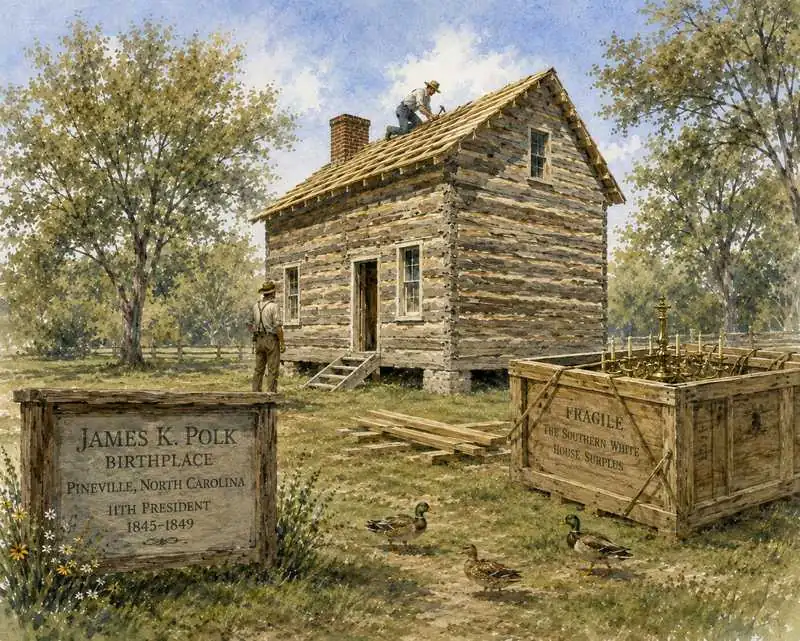
Three weeks later, in Pineville, North Carolina, a state historic site interpreter who had given tours of the Polk Homestead for eleven years stood in the yard, watching a man in indoor sunglasses pace off the property with a laser measure. In eleven years, nobody had ever asked her, with a straight face, where the room was.
"There is no room," she said, for the fourth time, and heard, only as she said it, how much it sounded like something she was telling herself. "This is a reconstructed 1800s farmstead. Four hundred square feet. There's a hearth."
"Fifty thousand square feet," the aide said, not looking up. "Marble. He wants it to feel like Polk would have had a ballroom. We need more gold here."
"He was a farmer's son," the interpreter said. "The house is small because he was a farmer's son who became president. That's the entire point of the house."
"Right, and the President feels that story is unresolved." The aide finally looked up, and for a moment something almost apologetic crossed his face, gone as quickly as it arrived. "He said — quote — 'nobody knows this guy, nobody knows what he did, we're gonna give him the room he deserves.' There'll be a mural. Polk on a horse. The horse is looking at Canada."
"Polk never owned Canada."
"Symbolically."
Behind them, a flatbed idled with a single crated chandelier the length of the cabin itself, stamped FRAGILE — THE SOUTHERN WHITE HOUSE SURPLUS, as though even the light fixture had once belonged to someone larger and had been sent north to make itself useful.
The interpreter looked at the log cabin, at its rope barrier, at its small brass plaque — Here, in 1795, was born a man of humble means — and understood, with the specific dread of someone whose job it is to protect a small true thing from a much larger false one, exactly how this was going to go.
"There's a hearth," she said again, quietly, mostly to herself.
"We're keeping the hearth," the aide said. "He likes the hearth. Says it's authentic." A pause. "We'll add the ballroom to it."
Coda
The ballroom took four months, cost more than the rest of the historic site had spent on itself in a century, and required the chandelier to be modified twice because the original didn't clear a ceiling that had already been built to a specification the Supreme Court had yet to change its mind about. At the ribbon-cutting he called Polk "one of the toughest, strongest, most underrated presidents we ever had — one term, imagine that, didn't even need a second, that's confidence" — and got both of Polk's dates wrong in a way the press corps could neither correct nor cover.
A junior aide, the kind hired mostly to carry briefing binders and absorb blame, had been assigned to compile a one-page fact sheet for the event. She found the Lincoln line almost by accident, buried in a footnote — how Congressman Lincoln, freshman, mostly ignored, had stood up and asked Polk to name the exact spot where American blood had first been shed on American soil, since the spot in question was, by any honest reading, Mexico's. Polk never answered him. Nobody remembered the question. Everyone remembered the war.
She put it on page two, small font, under "Additional Historical Notes." Nobody read page two — it had not, after all, come from the woman with the printer, and so it had never really had a chance. It stayed folded in the chief of staff's jacket through the ribbon, through the applause, through Drumph's hand running admiringly along a marble column that hadn't existed six months earlier, over ground that hadn't asked for it, and that — four hundred square feet away, behind glass, unbothered by any of it — still held a hearth, and the specific, stubborn smallness of a true thing.
Back in Washington, the tub had gone cold hours ago. The book on Polk sat closed on the ledge, a damp ring warping its cover. The duck, with nobody left to make waves for it, drifted in a slow circle toward the drain — the only thing in the whole affair that seemed to already know exactly where it was headed, and had made its peace with it.

All the World’s a Stage
Make sense of the week's news.
Charlatan reviews the worldview.
CHARLATAN
The Exposé of Politics & Style