CHARLATAN
The Exposé of Politics & Style

A bitterly divided Senate narrowly confirmed Todd Blanche as the U.S. Attorney General yesterday (50-49), but only after as acting AG he killed the $1.8 billion "Anti-Weaponization Fund" designed to compensate people the President considers victims of political persecution by his own government. It was bundled as a rider — already rejected once by a federal judge as improper self-dealing — granting the President and his family retroactive immunity from tax audits. It emerged from the settlement of the Trump family's own lawsuit against the IRS and its survival had become the price of confirmation for the man who signed its death certificate — two Republican senators told Todd Blanche, bluntly, that he would not become Attorney General while the fund stayed on the books. Senator Thom Tillis called it, “the payout pot for punks.”
Moreover, Trump Media & Technology Group is now shopping to traders and investors a premium version of Truth Social delivering early access to the feeds of high-profile users, including the president. Starting Saturday, for a fee of up to $100,000 a month, trading firms can access "Truth API" to get a glimpse of the president's often market-moving announcements about economic policy and global affairs before the rest of the world.
The presidency itself is now a subscription tier.
If not an executive order or policy initiative maybe by auction? If clearly reported in the public square, the U.S. President can sell early access to his social media posts just milliseconds ahead of the rest of the republic—for a fee. A minor founding father wasn’t above it, either. William Duer, a signer of the Articles of Confederation, used inside knowledge from his post at the Treasury to corner the market on U.S. securities. Triggering the Panic of 1792, the nation's first market panic caused by speculation, he died in debtors' prison.
To wit, many delegates at the 1787 Constitutional Convention were among the wealthiest men in the colonies, holding private land, government bonds, and commercial property that a federal government couldn’t secure. The Constitution gave the new federal government the power to tax and pay back public debts in full, directly restoring the value of those securities.
A century on, the Vanderbilt empire was amassed through aggressive corporate competition, shipping, and railroad monopolies, but its massive fortune was secured by government bonds to preserve capital; Steel magnate Andrew Carnegie’s empire was amassed through industrial steel production and vertical integration, but his personal fortune was secured using corporate gold bonds; and M&A powerbroker J.P. Morgan went further still. When the U.S. Treasury ran short of gold in 1895, and the banks seized up in the Panic of 1907, Morgan single-handedly bailed out the nation. From monetary and anti-monopoly policy, exemptions from federal antitrust policies, and creating the Federal Reserve, it can fairly be said that the men who built America didn’t live on Main Street. They dwelled in a kind of hieroglyphical world called Wall Street.
Cut to JPMorgan Chase admitting to manipulating markets, most notably in 2020 when the bank agreed to pay more than $920 million to settle charges of spoofing—a form of market manipulation—in precious metals and Treasury futures markets. Vanderbilt, Carnegie, and Morgan were all accused of stock manipulation, and the Iran war bluster offers the same managerial brio. On the same Sunday Blanche was signing his order, Trump told reporters aboard Air Force One that a deal with Iran was imminent. Negotiations, he said, would begin Monday afternoon. He’d gratuitously called off what he described as the largest American strike since World War II to make room for it. Gulf allies had asked him to. Iran had asked him to, he confirmed. On Monday, Iran's Foreign Ministry offered clarification: "We currently have no negotiations with the United States." Stocks surged on the news — not on the threat of violence, but on Trump's signal that he'd chosen diplomacy and the conflict was nearing an end.
Back in reality, BLS reports that inflation has cooled slightly to 3.5% — though Wednesday's report will offer the clearest picture yet of where prices stand for the fiscal year. Unemployment ticked down to 4.1% in July, but only because the labor force shrank to its lowest participation level in five years. The U.S. economy unexpectedly lost 23,000 jobs last month, and gas has climbed back to $4.02 a gallon nationally, according to AAA. Meanwhile, the costs of housing, groceries, insurance, and healthcare continue to outpace wage growth. The United States is heading into the 2026 midterms with not only a cost-of-living and affordability crisis, but the murmurings of a dystopian Universal Basic Income (UBI) in the not-too-distant future.
Presiding New York City mayor and democratic socialist Zohran Mamdani runs the opposite play in Trump’s hometown. While Trump fills every conceivable soundbite with stock-rollicking bombast, Mamdani leaves unfinished sentences dangling for others to complete. Asked directly how he’ll square Artificial Intelligence or a UBI in the largest financial city in the world Mamdani replies, "diplomatically.” A cryptic and frankly hostile description from a man whose statements are crafted with promising declarations and answers are couched with problematic clauses.
As the Democratic National Committee (DNC) enters the 2026 midterms roughly $17.5 million in debt, the Republican National Committee (RNC) is sitting on $95 million in cash. The Soros family, which gave the DNC more than a million dollars in the last midterm cycle, has given nothing this year; while Party Chairman Ken Martin dodges internal calls to resign amidst hurling telephones at staffers "in a pique of frustration."
Where institutions fail, individuals improvise. The DNC itself posted one of its strongest small-dollar fundraising months on record — $7.5 million, driven not by the committee but rather candidates and a new voter registration push. Rep. Alexandria Ocasio-Cortez has raised $32.6 million this election cycle. She's building a national war chest with no national campaign attached to it—yet.
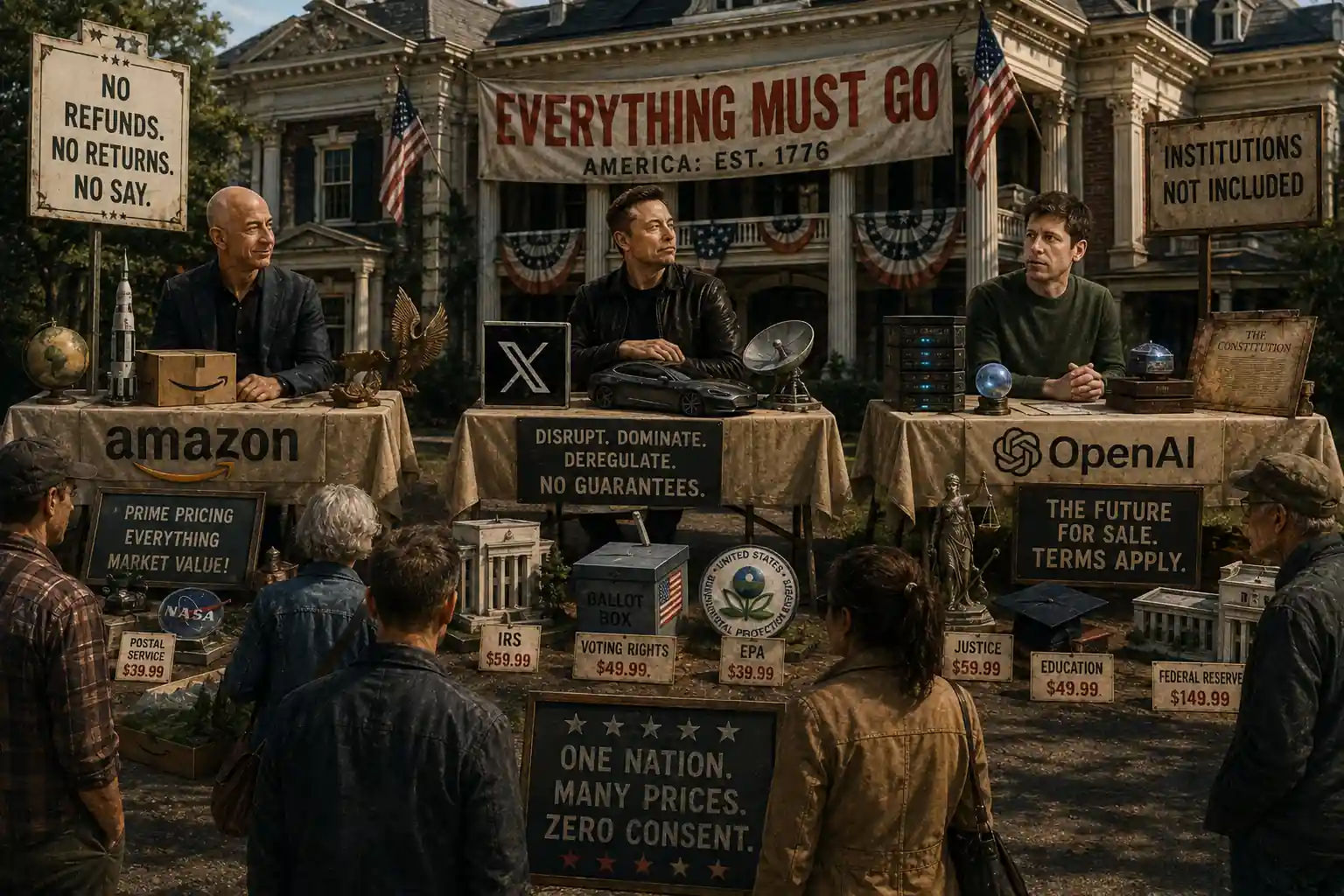
For a country that didn’t order up the Affordability Crisis; didn’t foresee the AI revolution; and cannot fathom or even comprehend a UBI we turn to the highest bidders in the room. Open AI’s Sam Altman leads this chorus. He suggests the remedy is access, not currency. Distribution through use of the technology itself, framed as "universal basic compute.” Elon Musk is offering us a check: Direct cash transfer, branded "universal high income," federally issued; and Jeff Bezos is pricing a tax bracket. Withholding rather than giving; the bottom half simply stops paying in.
Mark Zuckerberg wrote a WSJ op-ed arguing superintelligence must reach individuals directly rather than staying concentrated inside a small number of institutions. He proposes it be built on three stated principles: individual empowerment as the source of prosperity; invention as the primary purpose of superintelligence; and balance of power as the foundation of safety. He calls it "personal superintelligence,” and, notably, names no other labs. However, the positioning is unmistakably aimed at the field's centralizing tendency, meaning Altman and the OpenAI model specifically.
Finally, the American AI Sovereign Wealth Fund Act 2026. A one-time 50% tax on the largest AI companies, paid in stock rather than cash, seeding a public sovereign wealth fund. The government would hold voting shares and equal board representation at each company, giving it real power to block harmful decisions. Bernie Sanders argues: AI is built on the collective knowledge of humanity; wealth should benefit humanity; not just the 1% who own more wealth than 95% of all humanity.
Major AI and tech companies are increasingly owning or directly controlling power plants and building private transmission lines, rather than solely relying on public utilities. Faced with massive energy demands for data centers, companies like Amazon, Meta, Google, and Microsoft are actively building, buying, or partnering to secure dedicated, 24/7 power. The global AI market is projected to grow from roughly $539.5 billion in 2026 to over $3.4 trillion by 2033. Roughly the annual GDP of France.
Perhaps a public wealth fund — ensuring that the people directly share in the AI-driven economic growth — is the way forward, and with a scant 12-weeks to the midterms a few tips for the auction. 1) Set a hard ceiling in writing before you walk into your polling place; 2) Price the item yourself, catalogue estimates are for sellers, not appraisals for buyers; and 3) remember that the auctioneer works for the house, paid on the sale, representing no one's interest but the transaction's completion. A shill bid or a hidden reserve can move a price without anyone in the room breaking a rule. As the men who built America can attest.
Above all, understand that the fall of the hammer is the actual moment of consent, and that November 3, 2026 — the first Tuesday after the first Monday in November — is the last chance to bid, steal, or get in under the hammer.

All the World’s a Stage
Make sense of the week's news.
Charlatan reviews the worldview.
CHARLATAN
The Exposé of Politics & Style